
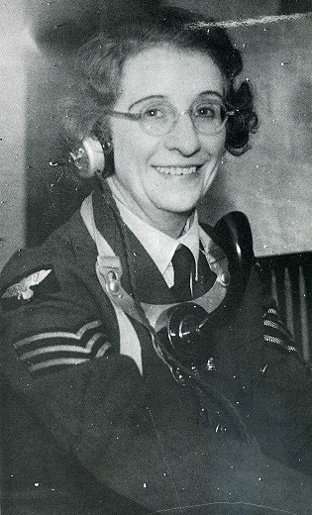
When Helen Turner answered the nation's call to arms in 1939, she had no idea that within a year she would be one of the first three Women's Auxiliary Air Force personnel to be awarded the Military Medal. Of the 215,000 women who served in the WAAF during the war, only six won this distinction.
1939 saw Helen Turner volunteer her services in the nation’s time of need for a second time. Her courage and devotion to duty had already been evident when she served alongside the Royal Flying Corps during WWI. As the Spanish Flu pandemic had raged through her camp, she had ignored the usual patterns of shift work and stayed at her post for a full week. Only when finally relieved did she collapse and allow herself to be taken to hospital.
By the Battle of Britain, Helen was a sergeant switchboard operator in the operations block at RAF Biggin Hill; a key point in Britain’s air defence system and high on the Luftwaffe’s target list during its airfield blitz of September 1940.

Helen Turner’s Military Medal. © RAF Museum.

(l-r) Joan Mortimer, Elspeth Henderson and Helen Turner outside the bomb-damaged buildings at RAF Biggin Hill. © RAF Museum.
Direct hit
In one of two particularly heavy daylight raids on Biggin Hill, bombs dropped all round the building in which Helen, operating the telephone exchange, and Corporal Elspeth Henderson were on duty. They stuck to their posts.
Even when the building received a direct hit and debris fell around them, they refused to leave until the flames began to spread, communications were cut off, and they were ordered to find their way out of the flaming ruins.
“We had to crawl out through the wreckage,” recalled Helen afterwards. “I felt a bit sorry for some of the youngsters in the building at the time, because it was their first experience of bombs. I did my best to cheer them up.”
Elspeth Henderson said: “There wasn’t much else we could do, was there? We joined the WAAF because we wanted to do something in this war, and when we found ourselves under fire, as it were, we simply carried on with the work we were doing.”
The other member of the trio whose courage won them the Military Medal was Sergeant Joan Mortimer, who remained at her post in the ammunition-filled station armoury while bombs rained down, passing instructions by telephone to defence posts round the airfield. When the raid was over, she ran out to the aerodrome with red flags to mark the locations of all the unexploded bombs.
After the raid, the station’s commanding officer said of the trio: “They showed amazing pluck and I am proud to have them on my station. Their example during those two days of bombing inspired all around them.” Their Military Medals were later re-awarded as the George Cross Medal.
Such was the bravery exhibited by Helen Turner, Elspeth Henderson and Joan Mortimer that soon after the event their heroics became the subject of a leading article in the London Evening News.
Later, Helen Turner broadcast to America and Dame Laura Knight painted a portrait of her standing beside Elspeth Henderson as one of a series of official war pictures which were exhibited in the National Gallery.
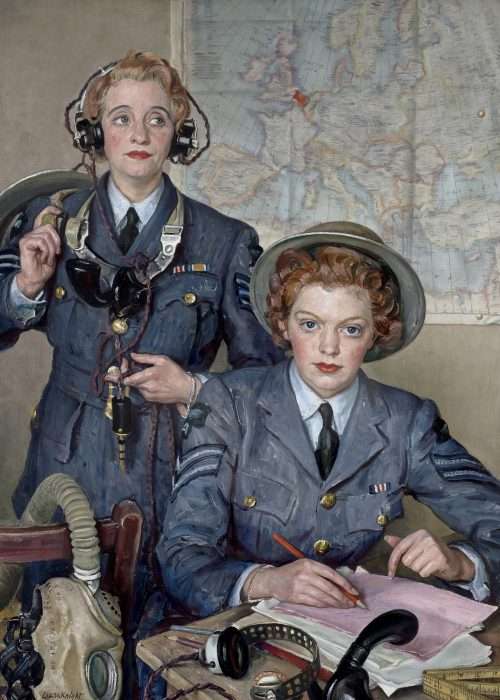
1941 painting by Dame Laura Knight depicting Sergeant Helen Turner (left) and Corporal Elspeth Henderson. Public domain.
Undaunted
After the war Helen Turner became an active member of the RAF Association. Just before her death in 1953, she described the indomitable spirit of her fellow WAAFs in the following personal story submitted to Air Mail:
“The girls at Biggin Hill showed no less a degree of nonchalant pluck [than their male counterparts in the skies]. Blitz or no blitz, Hitler or no Hitler, nothing disturbed them.
“Evening time, down they came – tunics pressed, buttons shining, their dear little mugs made up in full war paint. And out they sallied, gay and expectant into that inferno of noise and stink which was the night blitz.
“Heaven help those who ignored the risks of trying to prevent them from keeping their date. They usually hunted in couples, these kids. I must confess there were times when even I, who knew them so well, was sometimes anxious until, with the scurry and bump at the door, back they came full of triumph, their minds dwelling not on the trials and tribulations of the morrow, but on the success of their evening out.
“I remember how one night while the girls were out, we brought down sheets and blankets from the top floors of our quarters and made up beds on the floor of the large entrance hall where it was considerably quieter. A few days afterwards, down came what we knew from the sound would be a direct hit, but the dear old cedar tree which stood sentinel outside reached up and caught the beastly thing in its arms. He suffered badly that old tree, but he saved us from harm.
A few days later, when we were crowded together in the mess during one of those unprecedented hushes, there came the familiar, ominous, slithering sound much too near for comfort. As one, we flung ourselves down instinctively, only to scramble to our feet again a second or two later with sheepish grins on our faces. It was only that gallant old cedar tree. In its last pangs of suffering he had heeled over, brushing the window with his noble old head.
“What followed was true to RAF form. Someone supplied us with a blinking great hacksaw and we sawed him up for the winter nights that were to come. Doing us service to the last, his end was a fragrant funeral pyre.
“That’s how life was under the great black pall of smoke which pinpointed ‘Biggin Bump’ for our own boys and the enemy. That’s how the girls were then, how they are now, I expect, and how they will be again, I bet.
“You can call me a sentimental old fool if you like. Good job. I don’t care. It’s all so good to remember, why should I want to forget?”
Portraits of bravery
During WWII more than 640,000 women served in the UK's armed forces, with just over a quarter serving in the Women's Auxiliary Air Force (WAAF). Many more flew unarmed aircraft, drove ambulances, served as nurses and worked behind enemy lines in the European resistance in the Special Operations Executive. Here are just a few of their stories.
Noor Inayat Khan GC
WAAF-trained Noor was the first female wireless operator to be sent to occupied France by SOE. She was determined to continue with the mission though the group to which she had been assigned had already largely been been captured. The situation was so dangerous that SOE arranged her evacuation in August 1943, but she insisted on remaining. The next month she was betrayed to the Germans. Noor repeatedly refused to cooperate and made several attempts to escape. In November 1943 she was sent to Pforzheim Prison in Germany where she was kept in solitary confinement. In September 1944 she was transported to Dachau concentration camp where, on 13 September, she was executed. Her George Cross citation ended by stating that Noor had "displayed the most conspicuous courage, both moral and physical over a period of more than 12 months."
Joan Daphne Mary Pearson GC
Citation: "On the 31 May, 1940, at 0100 hours an aircraft crashed near the WAAF's quarters, the pilot being seriously injured, another officer killed outright and two airmen slightly injured… Corporal Pearson rushed out to it and, although the aircraft was burning and she knew there were bombs aboard, she stood on the wreckage, roused the pilot, who was stunned, and assisted him in getting clear, releasing his parachute harness in doing so. When he was on the ground about 30 yards away, a 120 lb. bomb went off. Corporal Pearson at once threw herself on top of the pilot to protect him from blast and splinters. Her prompt and courageous action undoubtedly helped to save the pilot's life."
In 1995 a newspaper article about Daphne's heroics led to her meeting the pilot whose life she had saved after his son recognised the circumstances surrounding his rescue.
Odette Sansom GC
Odette Sansom infiltrated occupied France and worked with distinction until April 1943, when she was arrested with her commanding officer. Taking full responsibility, she caused the Gestapo to cease paying attention to her CO after only two interrogations. The Gestapo were also determined to discover the whereabouts of two British officers whose lives were of the greatest value to the Resistance. As Odette was the only person who knew their whereabouts, the Gestapo seared her back with a red hot iron and pulled out all of her toenails. Odette's continued refusal to give away any information not only saved the lives of the two officers but also enabled them to carry on their vital work. Her George Cross citation stated that: "During the period of over two years in which she was in enemy hands, she displayed courage, endurance and self-sacrifice of the highest possible order."

Sketches in The London Illustrated News depicting the heroics of the three Military Medal winners. © Illustrated London News/Mary Evans Picture Library.