In 1940 the lives of a Czech airman and a German Shepherd puppy became inextricably linked while fighting for survival in no-man’s land. Author and war reporter Damien Lewis tells their story.

Robert Bozdech’s flying dog of war. © the Bozdech family
Robert Bozdech eyed the abandoned farmhouse warily. Even if the enemy hadn’t seen exactly where their aircraft had gone down, a giant black fist of smoke now rose above the trees to mark their position. Having left his injured pilot nearby, he had to find somewhere safe to move him before the German patrol arrived.
As a Czech national who had escaped the Nazi occupation of his homeland to fight with the French Air Force, Robert knew there would be no prisoner of war camp for him, only a firing squad.
It was the winter of 1939–40 and Germany and France were locked in the so-called ‘phony war’, though having just been shot down in the no-man’s land between French and German lines, there seemed nothing phony about it.
Once inside the farmhouse, a sound caught Robert’s ear. Cautiously moving aside a chair, he saw a sleeping figure.
One moment there was a tiny ball of curled up fluff, the next it had stumbled to its feet and was peering up at him anxiously, growling out a throaty little challenge.
Robert whisked the puppy up by the scruff of its neck and clutched it to his chest. He couldn’t leave it here, with no food and at the mercy of shelling from both sides.
That night he, his injured pilot and the puppy crept through the darkness to return to French lines.
Much of the next few weeks and months Robert spent moving from airfield to airfield, fighting a rear-guard action against the German advance with his new puppy often in the aircraft beside him. Yet despite their courageous resistance, on 17 June 1940 the announcement was made that France would sue for peace with Germany.
Determined to fight on, Robert, his newly-named puppy Ant and a group of fellow Czech airmen headed for the UK. They arrived on 12 July, having escaped from occupied France via Gibraltar.
Once there, Robert found that the way he pronounced ‘Ant’ was causing confusion among the Brits, with many assuming he was saying ‘aunt’. So Ant now had to be known as Antis – a minor alteration which he hoped wouldn’t confuse the dog too much
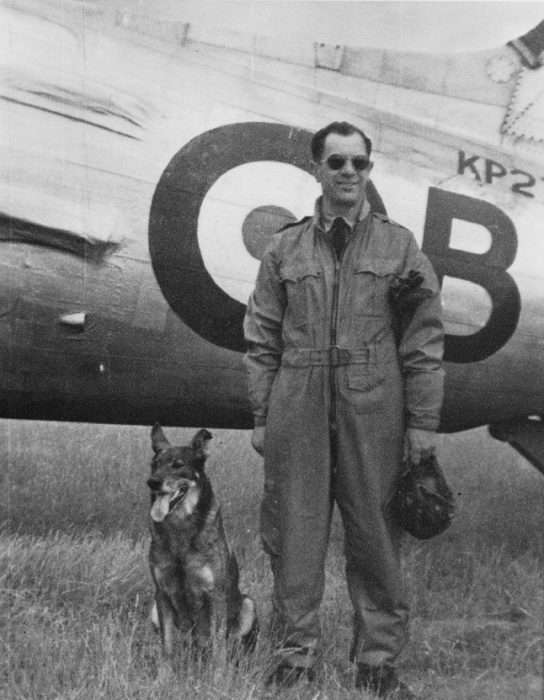
When Robert suffered injury on a sortie and was hospitalised, Antis waited for days in the cold and rain beside the runway for his master’s return. © the Bozdech family
With the RAF
Having signed up with the Royal Air Force, Robert was transferred to RAF Speke. Walking back to base with a few friends after an evening out in Liverpool, Antis suddenly became rigid. Moments later flares popped into life above them.
With no cover in sight, Robert threw himself flat on the pavement, pulling the dog beneath his body to shield him from the blast.
The screeching of the bombs turned to a roar as they tore through the buildings. Dropped with delay fuses, they exploded deep inside their targets, punching out walls in a whirlwind of shattered masonry, and firing debris at the speed of bullets over the heads of those lying prone in the road. In moments it was over.
With cries for help all around, Antis led the way with Robert and his friends close behind. They found and freed one man, and as more rescues followed the assembled helpers watched Antis like hawks, knowing he would lead them to the next casualty regardless of the twisted metal and broken glass which littered the ground.
Searching for his seventh survivor, Antis raced ahead of his master when there was an almighty crack. Before Robert knew what was happening a wall had collapsed in front of him. The lead went slack in his hand.
For several seconds Robert stood dumbfounded, then he fell on the rubble and began to frantically dig. Miraculously the dog’s head soon appeared, covered in dust but moving.
Robert began to sob. He didn’t care who saw the tears coursing through the dust that coated his cheeks. Antis was alive and that was all that mattered.
It was well after midnight when they arrived back at camp. For the last few hundred yards he’d had to carry his exhausted dog, so painful had his paws become to walk on. Both went straight to the sick quarters, where Robert began to painstakingly clean his dog’s cuts and bandage his bleeding paws. Not until he’d finished tending to Antis did Robert accept any treatment for his own cuts and bruises.
Not long after the air raid on Liverpool, RAF Speke was also bombed. Caught in the blast, Antis was buried beneath the rubble for a number of days before digging himself out. Once again Robert nursed his puppy back to health.

Antis was wounded on more than one occasion. In later life, one ear would droop due to an old injury sustained while flying. © the Bozdech family
311 (Czech) Squadron
As the RAF’s raids on enemy territory intensified, Bomber Command’s losses climbed at a dizzying rate. Brave airmen were needed to fill the vacancies, and Robert had no hesitation volunteering to join 311 (Czech) Squadron as an air gunner.
On New Year’s Day, 1941, they flew into RAF East Wretham. They were met by a sea of familiar faces, including a few of the original airmen Robert and Antis had escaped from France with. Once he had finished dashing about in joy, Antis went from man to man, seemingly checking that all were present. Not all had survived the dangers of war however.
Each time Robert climbed aboard his Wellington and disappeared into the sky, he would entrust Antis to their dog-loving ground crew chief Adamek. Once the aircraft was out of sight, no amount of coaxing by Adamek could get Antis to leave the dispersal area until Robert’s return many hours later. As losses mounted, Robert became painfully aware that if ever he failed to return he would be leaving behind an orphaned and very likely traumatised dog.
During one raid a shell burst right beside Robert’s aircraft, sending a shard of metal through the Perspex gun turret. The aircraft was partially crippled, and Robert badly cut on the forehead. Back at the station, Antis watched the other bombers come in to land. As the morning wore on it became obvious that Robert’s aircraft was not returning and Adamek tried to move Antis off the dispersal area. He would not budge.
Coaxing him with a plate of roast liver didn’t help, and Antis continued staring at the sky even as the dark clouds rolled in. When it began to rain the ground crew built a shelter around him.
Later on, news arrived that their aircraft had made an emergency landing at RAF Coltishall, with Robert rushed to the nearest hospital. As there was no way of informing Antis of this happy fact he remained outside, refusing to eat. Special dispensation was soon made which allowed the still-injured Robert to be released from hospital for a few hours to come and fetch his dog.
Arriving at the station, Robert was gently helped out of the car. Antis tried to climb into Robert’s arms but was too exhausted to manage it. Instead, the wounded airman picked up his dog and carried him to the waiting car for the return journey to the hospital.
Airborne
Once fully recovered, Robert’s first raid was as part of a thousand-bomber operation to Bremen. Seated in the forward gun turret Robert’s thoughts turned to Antis. For the first time ever as they had taken to the air Antis had been nowhere to be seen.
Not far from the German coast, Robert was snapped out of his reverie when the navigator tapped him on the arm. When he turned to look the man was bent over his charts, oblivious to Robert staring at him. Puzzled, Robert gazed into the darkened belly of the aircraft, and in the dim light he caught sight of a familiar shape – a German Shepherd lying prone on the floor.
Recovering from the shock, Robert noticed the dog’s flanks were heaving, his lungs desperate for breath, which was very likely why he’d alerted Robert to his presence. They were climbing to 16,000 feet and Antis was having trouble breathing in the oxygen-starved atmosphere. Robert placed his oxygen mask over the dog’s nose, only removing it occasionally to take a breath when he himself felt light headed.
Soon flak was buffeting the aircraft, and the bright dazzling searchlights periodically illuminating the otherwise dark confines of the turret, but Antis remained calm throughout.
Upon their return, Antis was the first to jump out. Bouncing and prancing, he went through an ebullient war dance followed by several wild circuits around the aircraft. Robert and his fellow airmen couldn’t help but laugh at their dog’s antics.
A jeep soon pulled up and out jumped Wing Commander Ocelka. Although Ocelka was thoroughly smitten with Antis, regulations prohibited taking an animal into the air. The group fell silent as Ocelka surveyed the scene.
“Antis is back on form, I see,” he said in an ominous tone. “No guessing where he’s spent the night then.”
As Robert opened his mouth to explain, Ocelka threw up a hand to silence him. Climbing back into his jeep, he turned to Robert with a slight smile: “There’s a very good English expression: ‘what the eye doesn’t see the heart doesn’t grieve over’”. With that, he drove away.
The first days of July proved hugely demanding for 311 Squadron. Robert and Antis – now with a custom-built oxygen mask – found themselves flying raids every second night. Returning from one raid on Hanover, the crew were made all too aware of the dangers of flying with their four-legged crew member. With thick fog blanketing East Wretham and all nearby stations, they were advised by ground control to abandon their Wellington and parachute to safety. A brief discussion among the crew ended in a unanimous decision: they would instead attempt a crash-landing at nearby RAF Honington.
Nobody had said as much, but they all knew that if they bailed, Robert and his dog would have to jump together, and if Antis panicked both of them stood next to no chance of survival.
With almost zero visibility and the engines working on fumes, they nonetheless set down squarely on the runway; their mascot once again proving his worth.

Grounded
Despite their good fortune so far, the war over Europe was far too dangerous for this state of affairs to last.
Just after bombs-away on a raid over Mannheim, disaster struck when a shell exploded right underneath Robert’s aircraft.
The force of the blast almost flipped the Wellington over as a whirlwind of blasted steel fragments tore through the fuselage. Their pilot, Capka, struggled desperately with the damaged controls as more flak exploded all around. The crippled Wellington finally came back level, and they set a course for home. However, it was painfully obvious to the crew that their aircraft was far too fragile to allow any evasive action.
In the rear turret Robert fixed his eyes on the skies. Antis seemed remarkably calm after what they had just been through, and not for the first time Robert marveled at the courage and fortitude of his dog.
Suddenly the turret was illuminated by a searchlight before the terrifying sound of heavy cannon fire punched through the aircraft.
The crew steadied themselves for the final deadly attack when the searchlights seemed to fade. Capka had piloted them into a cloud bank. Looking down, Robert saw Antis looking up at him, but his eyes were glazed.
With a growing sense of panic Robert flicked on the turret light. The sight that met his eyes sickened him. His dog was lying in a slick of blood. He was lost for words, and could feel hot tears pricking his eyes. Antis had been injured before, but not like this. Robert held his dog’s head, gently stroking him for the long return journey. After a belly-landing at East Wretham, Robert kicked open the emergency exit door and ran – dog in arms – to the waiting ambulance.
While Antis recovered, Robert found him a mission of his very own, one designed to take his mind off being grounded: Operation Jacqueline.
Jacqueline was a four-year-old girl who lived near to the station. Her father had been killed at Dunkirk, and her mother and grandmother worked all day. With the family’s blessing, Robert set Antis the task of being the little girl’s babysitter, chaperone and protector. Very quickly there developed an unspoken understanding between dog and child, who would often head off together on whatever adventures Jacqueline had planned.
After a few more raids Robert’s tour of duty was at an end. It was a historic one for many reasons, but most notably – and tragically – because they were the first Czech aircrew to complete an entire tour without losing any members. Robert had completed 206 operational flying hours, many of which he had shared with his dog, and both he and Antis had been wounded in action.

Operation Jacqueline. Seriously wounded by shrapnel during a sortie over Mannheim, Antis was grounded and given the duty of looking after a local widow’s daughter. © the Bozdech family
Trouble
After a short Christmas break Robert received his new orders: a posting to a gunnery training school at RAF Evanton in the Scottish Highlands.
Before this however, Robert was sent to RAF Chelveston for a brief gunnery leaders’ course, and left Antis with a friend to avoid more paperwork for what would only be a few days apart.
Shortly afterwards, Robert received startling news – Antis had chased a sheep and been shot by a local farmer. He was recovering well, but there would be a hearing, and the police were arguing for Antis to be put down.
Robert couldn’t get time off from his course, so wrote to his former superiors for their assistance. When the hearing finally took place, their testimonies were read out, including that of Wing Commander Ocelka, whose letter played a key part in swaying the judge. A firm ruling was made against ending the life of such a veteran war hero, and the British press finally had proof – in sworn court documents – that the oft-rumoured flying dog of war existed. Soon Antis was frontpage news.
After a worthwhile but unsatisfying period at the gunnery training school, in Autumn 1943 Robert – now a flight lieutenant – and Antis were delighted to hear that they would be rejoining 311 (Czech) Squadron, now based just a few miles away at RAF Tain. The squadron had swapped Wellingtons for Liberators, and now formed part of RAF Coastal Command hunting U-boats in the North Sea.
Retraining as a radio and radar operator, Robert formed an integral part of the cockpit team. However, in contrast to when they flew in the rear gunner’s position, there was simply no room for the big German Shepherd in a Liberator cockpit. As such, Antis reverted to his old ways of sitting in the dispersal area until Robert’s aircraft returned; sometimes up to 12 hours later. Antis continued to serve as 311 Squadron’s mascot – albeit ground-based – as Robert served out the remainder of the war flying over the north Atlantic.
Home
On 15 August 1945, Robert flew with Antis and his fellow surviving Czech airmen back to Czechoslovakia. They received a heroes’ welcome, and Robert set about rebuilding his life in his native land along with his veteran friend and survivor, Antis, the now-famous dog.
Sadly, less than three years later Robert was forced to flee his homeland for a second time, in a daring and deathdefying escape. The country had fallen under the control of the Soviet Union, and the Communist purges targeted anyone with links to the West.
During a knife-edge escape, Antis saved the life of Robert and his fellow escapees on more than one occasion by warning them of approaching patrols, and in one case by attacking and driving off the soldiers.
Eventually, man and dog made their way to the UK where Robert rejoined the RAF. A year later, Antis was formally recognised as a war hero when he was awarded the Dickin Medal, commonly known as the ‘Animal Victoria Cross’.
In August 1953, after being at Robert’s side for 13 years, Antis passed away and was buried at the Animal Cemetery in Ilford. The gravestone holds a simple inscription:
There is an old belief
That on some solemn shore,
Beyond the sphere of grief,
Dear friends shall meet once more.
There follows a shorter inscription in Czech: Verný až do smrti – Loyal unto death’
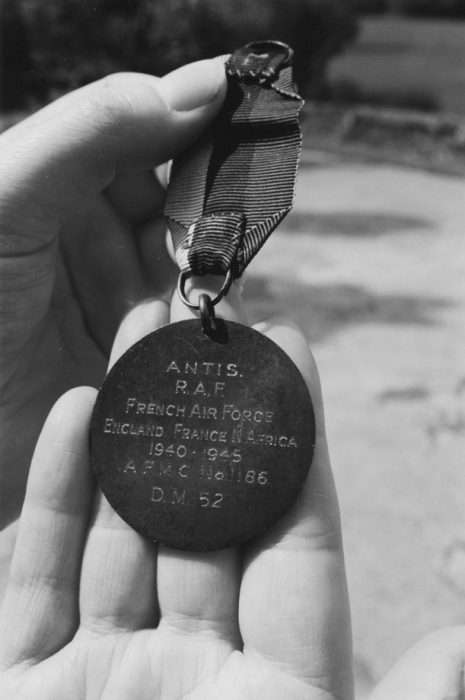
Antis’s Dickin Medal – the Animal Victoria Cross – ‘For outstanding courage, devotion to duty and life-saving actions while serving with the Royal Air Force’ © the Bozdech family