
The Battle of Britain through children’s eyes
We asked RAF Association members to send in their memories of that momentous summer. From dogfights in the sky, to sheltering from the raining bombs, this is the battle as seen through the eyes of those readers who were children at the time.
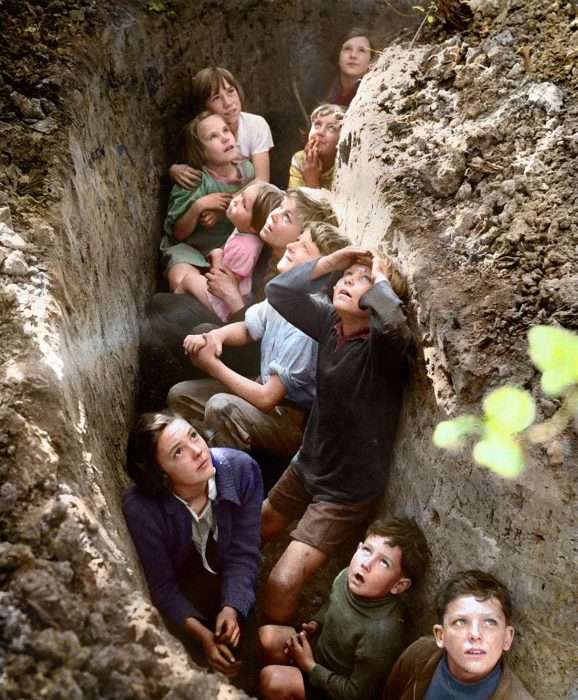
Hop pickers’ children from London shelter in a slit trench while watching a dog fight overhead. Summer 1940. ©TopFoto, colourised by ‘Piece of Jake’.
Children out playing in the summer of 1940 understandably found it difficult to appreciate the dangers of the months ahead. “Apart from the disruption caused by evacuees – which was all good fun – the end of 1939 and beginning of 1940 went by without us really knowing the war was on”, remembers Ray Duley, then aged 11.
The idea that aircraft would soon be fighting deadly battles overhead was too abstract, and the thought that bombs could intrude upon the small worlds of their childhood was so alien a concept as to be almost meaningless. For the children who lived through that summer, the first feeling when the children saw aircraft crowding the skies above was often one of youthful excitement.
Eight-year-old Eric Parrish remembers spending day after day in his garden in Ilford, east London, with eyes upturned: “The aircraft vapour trails, the puffs of bursting anti-aircraft shells, and the sight and sound of Spitfires and Hurricanes going into the German aircraft was exhilarating”, he says. “Every time we saw a parachute open everyone cheered”.
Joan Farmer, an Air Raid Warden at only 17, was impressed with the speed at which the sky could fill with aircraft. One day in Deptford, the siren suddenly rang out: “Within minutes the sky above was full of dogfighting aircraft”, she says. “Our Spitfires were unbelievable as they swooped around the German planes. It was an unforgettable sight.” William White, 12, was similarly impressed: “Spitfires and Hurricanes always attracted our attention, and fighter pilots of course replaced train drivers as the objects of hero worship.”
In Elham, Kent, a low-flying Messerschmitt Bf 109 appeared above five-year-old John Palmer one October morning, hotly pursued by an RAF fighter. “Suddenly, right above my head there was an enormous explosion” recalls John. “Pieces of aircraft fell all around. The engine came down on the cricket ground and the fuselage landed about 400 yards from where I was standing”. John remembers his father rushing to the scene before returning, “filled with sadness”. The young pilot, Oberleutnant Ludwig Lenz had still been alive in the wreckage, but died very shortly afterwards. “Underneath his tattered flying suit he’d been wearing tennis clothes and shoes” John recalls, “obviously hoping for a game when he returned to base.”
Close to the Thames Estuary in Essex, John Snoxall was watching the dogfights with his grandfather and brother late one summer afternoon.
“Granddad was standing by a large water butt in the garden, watching the sky” John remembers. “A spent bullet rattled down the roof tiles, hit his tin hat and plopped into the water butt. He looked up, shook his fist, told my brother and I to get to the Anderson shelter and shouted to the sky: ‘You’ll have to do better than that to knock me off!’”
As the battle progressed, many youngsters began looking to the ground as much as the sky, hoping to be the first to salvage a spent bullet casing or piece of German aircraft. “As a boy of that age I did what all boys seemed to do”, says William White. “I set aside a substantial box marked ‘Relics’, which was quickly filled with shrapnel, used and unused bullets and cartridge cases, a bottle of aviation fuel siphoned from a Me 110 together with a machine gun bullet tray, and a half burnt incendiary bomb; much-prized for its swap value.
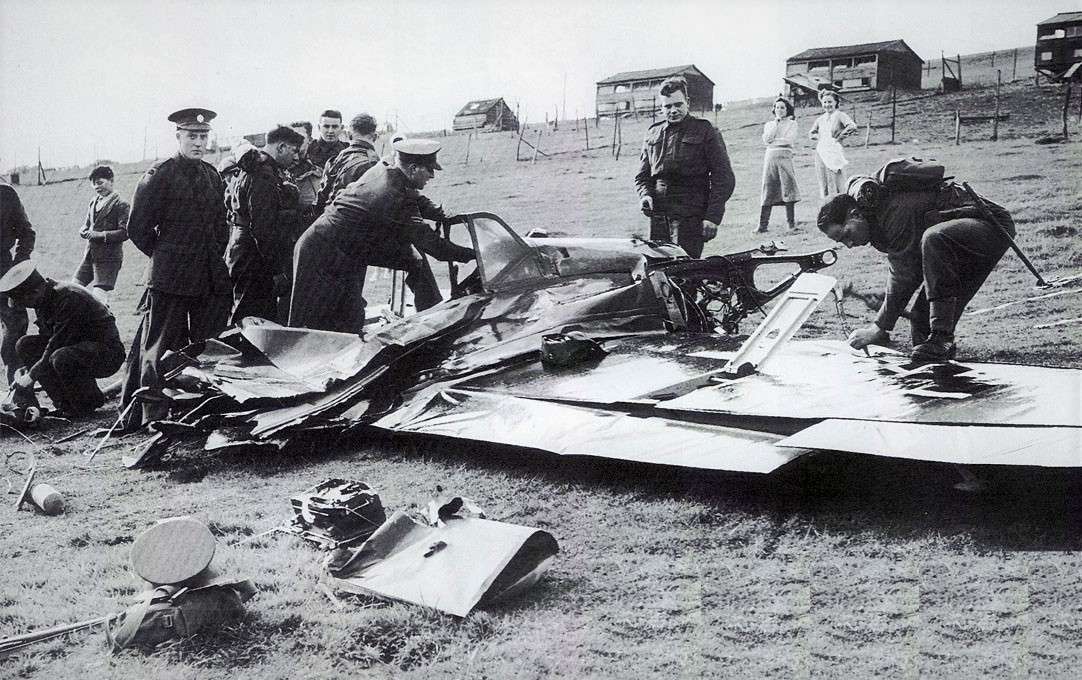
The wreckage of Messerschmitt Bf 109, piloted by Ludwig Lenz, which John Palmer saw shot down over Elham on 15 October 1940. Public domain
Not all ‘relics’ took the form of shrapnel then aged 11, discovered an enamel brooch in the shape of a horseshoe laying in his garden in Crowborough. Presumably it came from the cockpit, or pilot, of an RAF aircraft. In the centre of the brooch is a painted RAF crest, surrounded by a horseshoe adorned with four-leaf clovers; evidently a good luck charm.
The increasing dangers of battle could be made more bearable by focusing on these small, everyday pursuits. After enduring a night of “the most frightening noise” from a nearby battery of anti-aircraft guns, nine-year-old Geoffrey Moth remembers being consoled by the thought of all the shrapnel he could collect next morning on his way to school.

The ‘lucky’ enamel RAF brooch Ian Mein discovered in his garden in the summer of 1940. ©Ian Meinin
A change in routine
School life for children was another part of life affected since the beginning of the battle, more so when the Luftwaffe changed tactics.
Initially it had fought to gain air superiority against the RAF, but this focus shifted to targeting airfields and infrastructure, before the bombing of cities themselves.
“When the sirens sounded, we left the classroom and filed out to the shelters” says Brian Foster, a schoolboy in Sussex at the time. “If nothing happened the teachers might wander off, and those of us nearest the entrance would creep out to see what was going on. We often saw small planes weaving about – presumably engaged in dog fights.”
In Welwyn, Hertfordshire, Ray Duley was kept busy by his deputy headmaster when aircraft would appear overhead.
“Knowing I was a keen aircraft spotter”, recalls Ray, “Mr Wesley would ask me to go with him onto the school’s roof. Only if we recognised German aircraft would he send the pupils to the shelter.”
The nightly raids saw regular patterns of sleep become a thing of the past. When six-year-old Keith Carley arrived at school in Isleworth, he and his class would often be put back to bed – on mattresses out in the fresh air – to catch up on their missing sleep.

Keith Carley and other children classmates catch up on sleep at Marlborough Infants School, Isleworth, during the battle. ©Keith Carley
What time children were expected at school the next morning could depend upon what time the ‘all-clear’ had sounded the previous night. Five-year-old Trevor Todd and his sister would sit under a solid kitchen table playing with their toys during an air raid, but Trevor always had one eye on the clock. “If the all-clear sounded before midnight, we had to go to school at the normal time the following morning”, he recalls. “And if the all-clear sounded after 1am we started school at 10am. However, if the all-clear sounded after 3am we had the following morning off! I am afraid that as a young boy, this seemed more important to me at the time.”
Children were quick to acclimatise to the ever-changing situation. Five-year-old Ian Waller remembers playing in bombedout houses, and lighting fires to bake potatoes in a crater behind his house in Hornchurch. The combination of working or absent parents and a lack of schooling in areas under attack also resulted in reduced supervision. “My dad was an ARP Warden and my mother ran the shop” explains Ian. “There just wasn’t time for them to keep tabs on my brother and I every minute of the day.”
From spectators to participants
For those children living close to targets marked on the maps of German bomb aimers, the dangers soon became very real. “Our mother, in panic, grabbed us and hurried us into the shelter” says Brian Vousden, then aged seven, of one bombing raid. “We waited anxiously as the bombs fell closer until mother, sobbing, pulled us down and I heard a whistle followed by a very loud explosion. Everything seemed to shake.” While the bombs had narrowly missed his own house, one belonging to a police sergeant further down the road was obliterated.
Back in Hornchurch, Ian Waller remembers their Anderson shelter being permanently flooded, forcing the family to take refuge under the stairs of his parents’ tobacconist and confectioner shop. “During one air raid there was an almighty bang and the house rocked for a second or two” recalls Ian. “At the all-clear we found a crater 12 feet deep in front of our shop”. The cigarette machine had been blown clear across the street and parade opposite, only coming to rest after hitting another building.
The windows had also been blown out, and stayed that way until 1945.
Naturally, some children still found sheltering from the bombs a great game. Geoffrey Moth remembers the feeling of entering his Anderson shelter: “It seemed to be a great adventure to go into the shelter on hearing the air raid sirens” he says. “The fact that we were just below ground level muffled the sound of bombs exploding, although we learnt to gauge the size and place of nearby explosions as time went on.” Geoffrey had plenty of time to hone these skills. Living in south-east London, he spent 57 nights in the shelter during the early part of the Blitz.
Not every child warmed to life in the Anderson shelter however. Bill Hatherley, then a five-yearold watching German bombers stream overhead on their way to the nearby dockyards, says: “I couldn’t cope with being closed up in the shelter, so I used to stand in the sand-bagged area outside watching the bombers fly towards the city [as they were] caught in searchlights from the defences nearby.”
John Snoxall also remembers the times spent in an Anderson shelter made by his grandfather.
“It had a stout brick wall and earth bank protecting the entrance which faced into allotments at the bottom of the garden”, he says. “Once, we were all inside the shelter – except granddad, who was standing
between the entrance and the blast wall – when a bomb landed in the allotments. Granddad ducked just in time to avoid a very large cabbage that landed alongside him.” Naturally, John ventured onto the allotments with a wheelbarrow the next day to collect items for his box of relics.
No longer a game
The indiscriminate nature of aerial bombardment could impose radical changes on everyday life in a single moment. On 15 September, the block of flats in which four-year-old Derek Smith lived in London received a direct hit from a 500lb bomb.
“It destroyed our flat except for the front room bedroom in which my mother, brother and I were sleeping”, recalls Derek, and “the kitchen at the back of the flat where my father was – having just returned from Fire Brigade duty”. This was indeed a lucky escape, though not for the whole family: “Sadly my grandmother was killed in another bedroom”, continues Derek, “where my brother and I would normally have been sleeping.”
Joan Farmer, the young Air Raid Warden also enjoyed more than one lucky escape. While in charge of a shelter in the gardens of Peckham Library, an unexploded bomb landed so close it showered her with dirt. Another escape came when she was on patrol. “Through the darkness I heard a swooshing noise”, she remembers. “Looking up I saw a parachute mine appear over the roof of a house to my right. It floated over my head, across the road, over the roof to my left and exploded in the gardens behind”.
On the same day that Derek Smith’s home was bombed, 10-year-old Ron McGill from Vauxhall, London, experienced what he would later describe as “the most vivid moment of my young life.” Late that morning, while visiting relatives near Kennington Park, sirens began to sound. Ron picks up the story as he and his mother were running home amid the drone of aircraft engines and bursts of anti-aircraft fire:
“Suddenly, to our astonishment, we realised a German parachute was coming down on us. The parachutist skimmed The Oval cricket ground wall and landed by the doorway of a community centre. This centre was packed with survivors of the previous
Saturday’s bombing, and a crowd rushed out with as many weapons as they could grab. ‘We want nothing to do with this!’ said my mother as she dragged me away.”
The German airman, Robert Zehbe, later died of his wounds. Whether these were received when his aircraft was shot down or were inflicted by the crowd, is unknown.
A similar scene almost unfolded in front of 10-year-old Dennis Evans, who would later capture the moment the crowd arrived at the crash site in his poem ‘Low Flying Aircraft’:
Breathless, we survey the
enemy aircraft:
iron-black, swastikad.
Blood lust
Poised…
Police Constable Ridge faces
the crowd,
cycle-clipped trousers on wide
apart legs.
Flushed from the chase, he roars
out his sanity.
Saves fearful man
from pitchforks.

Bomb damage to Derek Smith’s flats. Derek was carried out of the first-floor window over the shoulder of a fireman. ©Derek Smith
Looking back
Despite the dangers and hardship, many children who experienced the Battle of Britain and the subsequent Blitz remember it as a time of genuine excitement. “I am so delighted that I was able to live through those times; they are still a vivid memory” says Eric Parrish.
Sydney Smith remembers being so impressed “that brave young men were risking their lives for my future that at that young age I determined to do something for the Royal Air Force.” Sydney would later do just that – serving four years with Princess Mary’s Royal Air Force Nursing Service. Indeed, the majority of those quoted in this article would go on to join the RAF.
While the rest of the war was still ahead of them, the dangers of 1940 had at least been endured. William White would later be caught beneath two disintegrating RAF aircraft
Air Mail
This article has been adapted from the summer 2020 edition of Air Mail magazine which was dedicated to the Battle of Britain. To receive Air Mail, which is the RAF Association’s quarterly members’ magazine and looks at all aspects of the RAF’s work, now and since it was founded, become a member and opt for Air Mail as part of your membership.