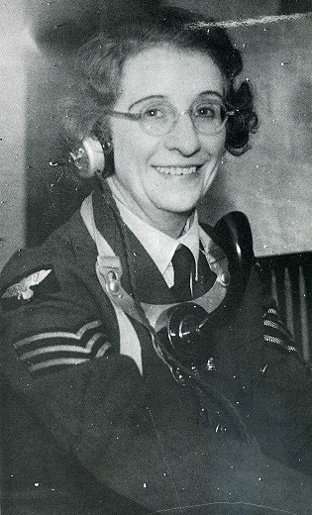
Women’s Auxiliary Air Force Sergeant Helen Turner MM witnessed an unexpectedly poignant moment in the signals room at RAF Biggin Hill in autumn 1940. In 1953 she told the story to Air Mail magazine.
“It happened in that memorable autumn of 1940. When the enemy was doing his very damnedest to remove from the war maps dear old ‘Biggin Bump’, as we referred affectionately to our own frontline airfield in Kent. Already our operations and signals blocks had ceased to exist, but we were continuing to play our part in the defence of Britain as strongly as ever, though in temporary buildings.
© Public domain
“One morning, after all hell had been let loose outside, there came a lull in the proceedings, and the door of my signals room opened to admit a tired and battle-scarred group of men in Air Force blue – our wonderful CO and his band of precious pilots. Those supermen who but a few moments before had landed after giving yet another courageous account of themselves during the fierce and numerous dogfights, which were by now a familiar spectacle to us all on those bright early autumn mornings.
“That most exalted person, the Chief Ops Controller, was there too. I scarcely dared to raise my eyes to see what was afoot. It was not for me, a humble Sergeant in the WAAF, to inquire why this formidable team of Churchill’s glorious Few, with their ringed cuffs and epaulets, be-medaled breasts and boyish faces, had retired to the quiet of the signal section during a lull in the storm. If it was to be a discussion on fighter combat tactics, on operational policy – or perhaps even on the slender chances of survival – then my ears should be deaf.
“There were shy glances in my direction and a sudden, spontaneous burst of boyish laughter from the group. Then, believe this or believe it not, with the same concentrated fervor and the same serious skill and accuracy with which each had bravely given his all to chase the Luftwaffe and its bomb loads out of the sky over Britain a short time before, these gallant gentlemen settled down to something which, for them, was no less exciting – a deadly game of conkers!
“It was never finished. Before either of the cases of their autumn-hard fruits cracked under the strain of alternate flailing, there came the urgent recall to battle, and back into the air went the youth of Britain to continue a grim task high above the fields of Kent.
“I wonder if – please God – from the quiet of Civvy Street, any of that group of the Few who survived should remember this incident, the morning when ‘they had a bash’ at conkers?
“What happened to the stringed weapons? Why, in their haste they left them on top of my switchboard, where I eyed them lovingly for weeks afterwards, like a fond nanny guarding precious toys. I always hoped that one of those heroes, those light hearted children, would return eager-eyed to claim them one day. They never did.”

© IWM CH 739.
Main image caption: Refuelling and rearming a Spitfire of 92 Squadron, RAF Biggin Hill, September 1940. © RAF Museum collection.
Women’s Auxiliary Air Force Sergeant Helen Turner MM witnessed an unexpectedly poignant moment in the signals room at RAF Biggin Hill in autumn 1940. In 1953 she told the story to Air Mail magazine. To mark the anniversary of the Battle of Britain, we reproduce it here.
“It happened in that memorable autumn of 1940. When the enemy was doing his very damnedest to remove from the war maps dear old ‘Biggin Bump’, as we referred affectionately to our own frontline airfield in Kent. Already our operations and signals blocks had ceased to exist, but we were continuing to play our part in the defence of Britain as strongly as ever, though in temporary buildings.
© Public domain
“One morning, after all hell had been let loose outside, there came a lull in the proceedings, and the door of my signals room opened to admit a tired and battle-scarred group of men in Air Force blue – our wonderful CO and his band of precious pilots. Those supermen who but a few moments before had landed after giving yet another courageous account of themselves during the fierce and numerous dogfights, which were by now a familiar spectacle to us all on those bright early autumn mornings.
“That most exalted person, the Chief Ops Controller, was there too. I scarcely dared to raise my eyes to see what was afoot. It was not for me, a humble Sergeant in the WAAF, to inquire why this formidable team of Churchill’s glorious Few, with their ringed cuffs and epaulets, be-medaled breasts and boyish faces, had retired to the quiet of the signal section during a lull in the storm. If it was to be a discussion on fighter combat tactics, on operational policy – or perhaps even on the slender chances of survival – then my ears should be deaf.
“There were shy glances in my direction and a sudden, spontaneous burst of boyish laughter from the group. Then, believe this or believe it not, with the same concentrated fervor and the same serious skill and accuracy with which each had bravely given his all to chase the Luftwaffe and its bomb loads out of the sky over Britain a short time before, these gallant gentlemen settled down to something which, for them, was no less exciting – a deadly game of conkers!
© IWM CH 739.
“It was never finished. Before either of the cases of their autumn-hard fruits cracked under the strain of alternate flailing, there came the urgent recall to battle, and back into the air went the youth of Britain to continue a grim task high above the fields of Kent.
“I wonder if – please God – from the quiet of Civvy Street, any of that group of the Few who survived should remember this incident, the morning when ‘they had a bash’ at conkers?
“What happened to the stringed weapons? Why, in their haste they left them on top of my switchboard, where I eyed them lovingly for weeks afterwards, like a fond nanny guarding precious toys. I always hoped that one of those heroes, those light hearted children, would return eager-eyed to claim them one day. They never did.”
Main image caption: Refuelling and rearming a Spitfire of 92 Squadron, RAF Biggin Hill, September 1940. © RAF Museum collection.
Air Mail
Helen’s story first appeared in our Air Mail magazine. To receive Air Mail, which is the RAF Association’s quarterly members’ magazine, become a member and opt for Air Mail as part of your membership.