Adolph ‘Sailor’ Malan was a South African volunteer now known as one of the greatest RAF fighter pilots of WWII. He also fought against the injustices of apartheid, which ravaged his homeland in the years following the war. Author and historian Dilip Sarkar MBE tells his story.
The Malans are a proud and ancient family, persecuted Huguenots originating in Italy before settling in the Franco-Italian Alps, and later seeking refuge in the Netherlands from religious oppression. During the 17th century, the Dutch became the dominant European settlers in South Africa, specifically around the Cape of Good Hope. There the Dutch welcomed Huguenot refugees, and their knowledge of French viticulture advanced the Cape’s prosperity.
Among these new settlers was Jacques Malan, who took a farm in Wellington, and over time the Dutch, German and Huguenot frontier farming communities fused together to share a common language, ‘Afrikaans’, and became collectively known as ‘Boers’.
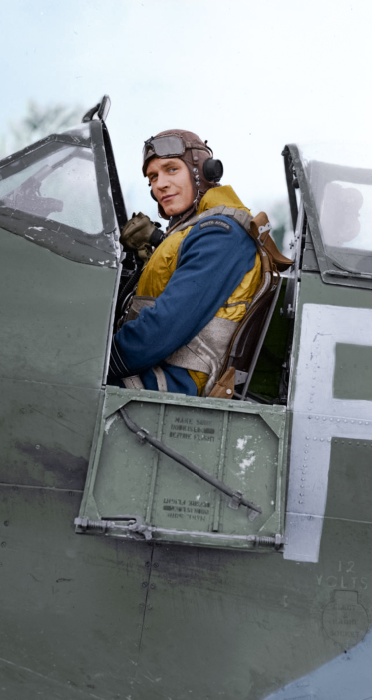
Group Captain Malan in his Spitfire at Biggin Hill. © Dilip Sarkar Archive. Colourised by Renee Chan.
In 1910 the British South Africa Act granted the country nominal independence, with the Union of South Africa becoming an entity on 31 May. This was also the year that Willem Adolph ‘Willie’ Malan married Evelyn Forde Jordan, an Englishwoman, and on 3 October Adolph Gysbert Malan was born. The British South Africa Act, coupled with the child’s birthplace of Wellington, made Adolph a South African by birth. His childhood on a farm at Slent was idyllic for Malan and his brothers, who roamed far and wide. Adolph, armed with a shotgun, was a natural marksman from an early age.
Afrikaner children attended farm schools, where Adolph experienced prejudice for the first time when a teacher, bitter about defeat in the Boer wars, was derogatory about the English. As the child of an English mother Adolph was unable to reconcile this. He would later say: “All that hatred, it left a nasty impression on my mind”.
After leaving school aged thirteen Adolph became a cadet, and it was from his time here that he picked up the nickname ‘Sailor’. During training however, Sailor found a culture of violent discipline and institutionalised bullying by older cadets. “He developed a stoic indifference, but it had a profound effect on him,” says relative Dr Yvonne Malan. “Not only because it made him tough, but because it solidified his fierce sense of justice and intense hatred of bullies.” This would prove a significant factor throughout Sailor’s life.

Sailor Malan’s ‘Ten Rules for Air Fighting’. © Dilip Sarkar Archive.
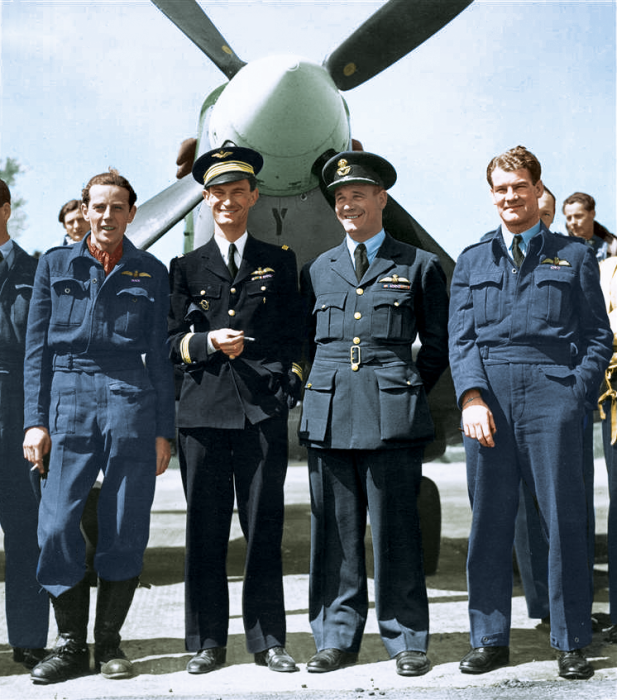
As Station Commander, Group Captain Malan poses with pilots from the wing who shared Biggin Hill’s 1,000th aerial victory. © Dilip Sarkar Archive. Colourised by Rarity Color.
With the RAF
After spending some years at sea in the mercantile marine, and becoming an officer in the naval reserve, in 1936 Sailor took advantage of RAF expansion. As the clouds of war gathered, he took a short service commission. Unimpressed by the Royal Navy’s “starch-ridden” attitudes and “lack of human relations,” Sailor noted that: “The difference in relationships when I joined the RAF was remarkable. I daresay that as a man from the Dominions I was to some extent favoured. The RAF liked chaps from the Empire”.
While the dynamics between personnel may have been different to the Royal Navy, and the RAF would soon prove itself to be socially and racially progressive, it was distinctly similar to Sailors’ South African naval experience: exclusively white. The Air Force (Constitution) Act of 1917 excluded recruits not of ‘pure European descent’ from serving in the RAF. In August 1923, the Air Ministry’s Recruiting Regulations for the RAF confirmed that the nationality and ethnic origin of recruits was restricted to those of ‘pure European descent and the sons of natural born or naturalised British subjects’. This remained the case when Sailor joined the RAF at twenty-five, a worldy-wise and well-travelled officer used to leading men and strongly opposed to injustice and cruelty.
After flying training, Pilot Officer Malan was posted to fly Gloster Gauntlet fighters with 74 ‘Tiger’ Squadron at Hornchurch, later converting to Spitfires. By the outbreak of war, Sailor, a fine aerobatic pilot, was a flight lieutenant and commanding ‘A’ Flight. Unfortunately, on 6 September 1939, he was leading 74 Squadron when a tragic incident of ‘friendly fire’ occurred, in which two Hurricanes were mistakenly shot down and a pilot killed. Not charged with any offence, Flight Lieutenant Malan appeared as a witness for the prosecution, although no action was ultimately taken against any of the parties involved.
The ‘Battle of Barking Creek’ remains a controversial and emotive subject, Malan having been accused of lying because the order he claimed to have given calling off the attack was unheard by the other Spitfire pilots. Recent research, however, suggests that this may have been because a radio-location device called ‘pipsqueak’ automatically blocked transmissions for fourteen seconds of every minute. This is not the place to forensically examine ‘Barking Creek’ but, suffice it to say, for Sailor to have lied would be contrary to everything we know about his character and integrity.
It was over Calais on 21 May 1940, just before the Dunkirk evacuation, that Sailor destroyed his first German aircraft, a He 111 bomber; it would be the first of many. Rapidly Sailor realised that Fighter Command’s pre-war tactics were wrong, and that many of the paradigms of First World War fighter combat still held true: height, sun, and getting in very close before opening fire. After Dunkirk there was a lull, until the night of 19 June 1940, when Sailor destroyed two He 111s to record the Spitfire’s first nocturnal victories.
By the Battle of Britain, Sailor was already an ace decorated with the Distinguished Flying Cross (DFC), and 74 Squadron would be heavily engaged throughout. Indeed, Sailor wrote that: “Taking a Spitfire into the sky in September 1940 often corresponded to entering a dark room with a madman waving a knife behind your back”. More victories followed, a bar to his DFC, command of the
‘Tigers’, and appointment to the Distinguished Service Order (DSO). In March 1941, Sailor was among the first wing leaders appointed, and until August 1941, with a bar to the DSO, led the Biggin Hill Wing on intensive offensive operations over France.
Recognising in himself the signs of exhaustion and the negative consequences of that for those he led into action, Sailor was rested at his own request. By then he was the RAF’s top-scoring fighter pilot with at least thirty-two enemy aircraft destroyed – a score only exceeded, in 1944, by Wing Commander Johnnie Johnson. Group Captain Malan then went into training as an instructor, writing his ‘Ten Commandments of Air Fighting’, before commanding RAF Biggin Hill. At the time of D-Day he commanded 19 (Fighter) Sector, and flew over the landing beaches with Free French Squadrons of 145 Wing.
The Second World War undoubtedly accelerated social change in Britain, and the RAF’s identity had changed beyond all recognition from the small, elite, service it had been pre-war. The service comprised professional airmen, amateur auxiliaries and volunteer reservists, men and women from the Empire and Commonwealth, and those from the occupied lands. In October 1939 the colour bar to service in the RAF had been relaxed, although numbers of non-white personnel remained comparatively small.
Nonetheless, the RAF had become a much more diverse and progressive service, and throughout nearly ten years as an air force officer, Sailor mixed and served with people from all over the world – cementing his already strongly-held worldview. When the war ended, Sailor, by then the father of two children, left the RAF and returned to South Africa.
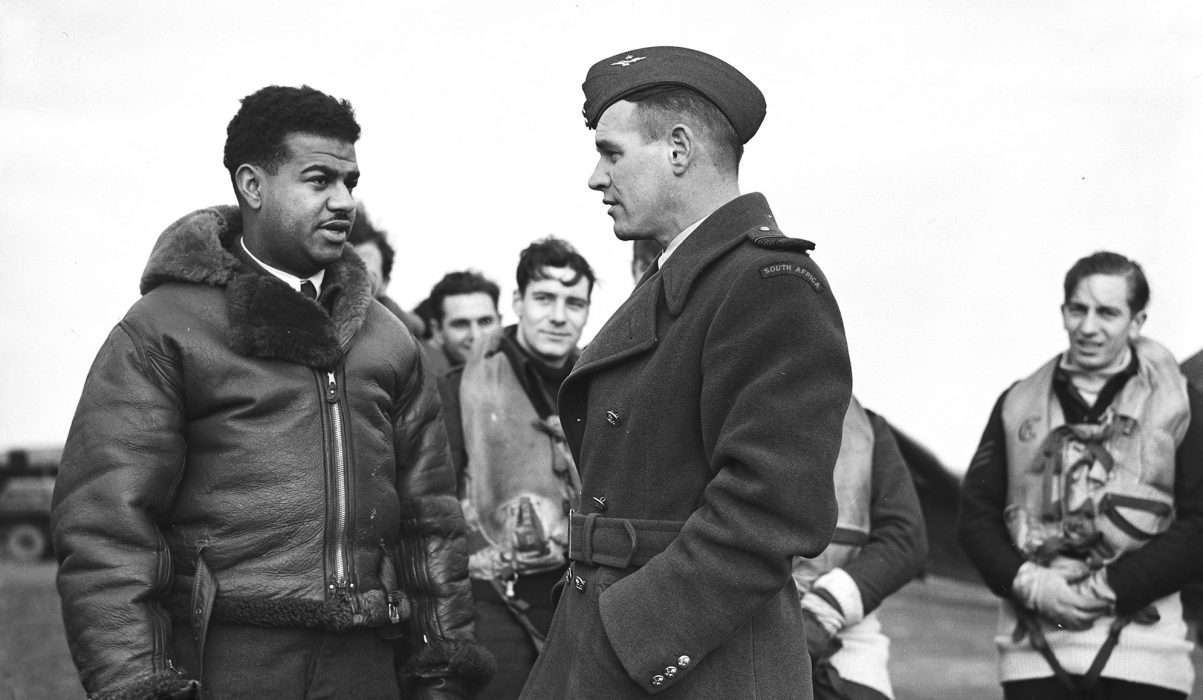
Group Captain Malan in conversation with the Jamaican Spitfire pilot Flight Sergeant Vincent Bunting of 72 Squadron at Biggin Hill. © Dilip Sarkar Archive.
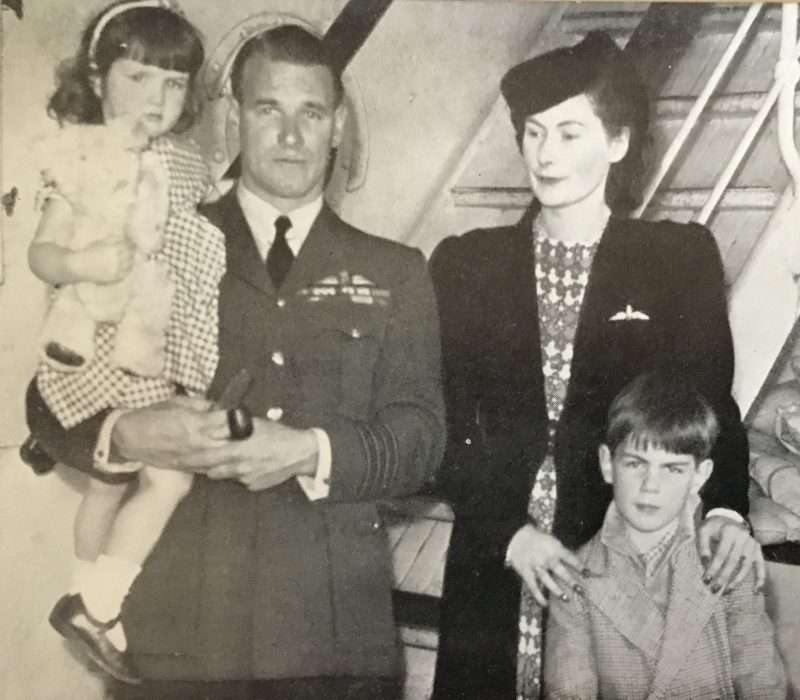
Sailor Malan with wife Lynda and the children, Jonathan and Valerie, on return to Capetown in 1946. © Dilip Sarkar Archive
From bullets to ballots
In South Africa the Afrikaners had been divided as to whether the country should fight for Britain. Scars from the Boer War still ran deep, and some had even believed in joining with Hitler against the old enemy. Not all from their own community saw Sailor and his three brothers, who also served, as heroes – some Afrikaners considered them traitors.
Back home post-war, Sailor was appalled by the actions of the racist Nationalist government. Various laws saw the country slide into overt fascism; interracial marriages became illegal, thousands of non-whites were removed from their jobs, and black South Africans were obliged to live on reserves and prevented from attending university.
In addition to violating basic human rights and dignities, this also created a vast economic gulf between the wealthy, who were almost exclusively white, and the poor, non-white masses – the majority of whom were black.
When black voters were disenfranchised and apartheid took hold, Sailor felt compelled to re-enter the spotlight, speaking out at multi-racial rallies all over the country. In one such rally, he accused the Nationalist government of depriving citizens of their freedom “with a fascist arrogance that we have not experienced since Hitler and Mussolini”.
Galvanising South Africa’s ex-servicemen to fight this injustice, Sailor was elected to presidency
of the anti-apartheid Torch Commando group. Among the organisation’s primary aims were: the protection of individual freedoms of speech, worship and language; the elimination of all forms of totalitarianism; and the promotion of racial harmony.
With 250,000 members, the government was rightly concerned about Torch Commando’s popularity. In retaliation, the nationalist party passed a law prohibiting anyone employed in public service or the armed forces from joining Torch Commando, and the nationalist-controlled media relentlessly denigrated the organisation and its leaders. With a chest full of medals and a claim to be South Africa’s greatest war hero, Sailor was seen as a traitor by the white supremacists who favoured the National Party.
In spite of all the opposition and activism, the National Party won the 1953 election, Torch Commando faded away and Sailor returned to farming. Offers to return to politics were declined, though Sailor did maintain his ties to the RAF, acting as President of the RAF Association’s South African Area and enjoying life membership of the Johannesburg Branch.
By 1959 however, he was very ill and travelled back to Britain to consult specialists for a ‘nervous disorder’ which turned out to be Parkinson’s. On 17 September 1963, aged just fifty-two, Sailor Malan passed away. Forbidden a military funeral by the Nationalist government, the occasion was nonetheless attended by thousands of people in Kimberley.
Sailor Malan was much more than the decorated fighter ace he is best-known as outside South Africa. A man of immense moral courage, surprisingly soft-spoken and bordering on being shy, he was arguably a model human being in every respect; a global South African and a true freedom fighter – no matter the odds – deserving his place in history and for his story to be told.

Sailor Malan, complete with iconic Irving flying jacket and medals, President of the Torch Commando and speaking at an anti-apartheid rally in 1948. © Dilip Sarkar Archive

The civic funeral of Group Captain Malan in Kimberley, 1963 – the nationalist government refused to honour South Africa’s greatest war hero with a military funeral.© Dilip Sarkar Archive.