The RAF Museum’s Dr Harry Raffal looks at an invention that turned the tide of aerial combat during the First World War, and became a must-have aircraft component for decades afterwards.

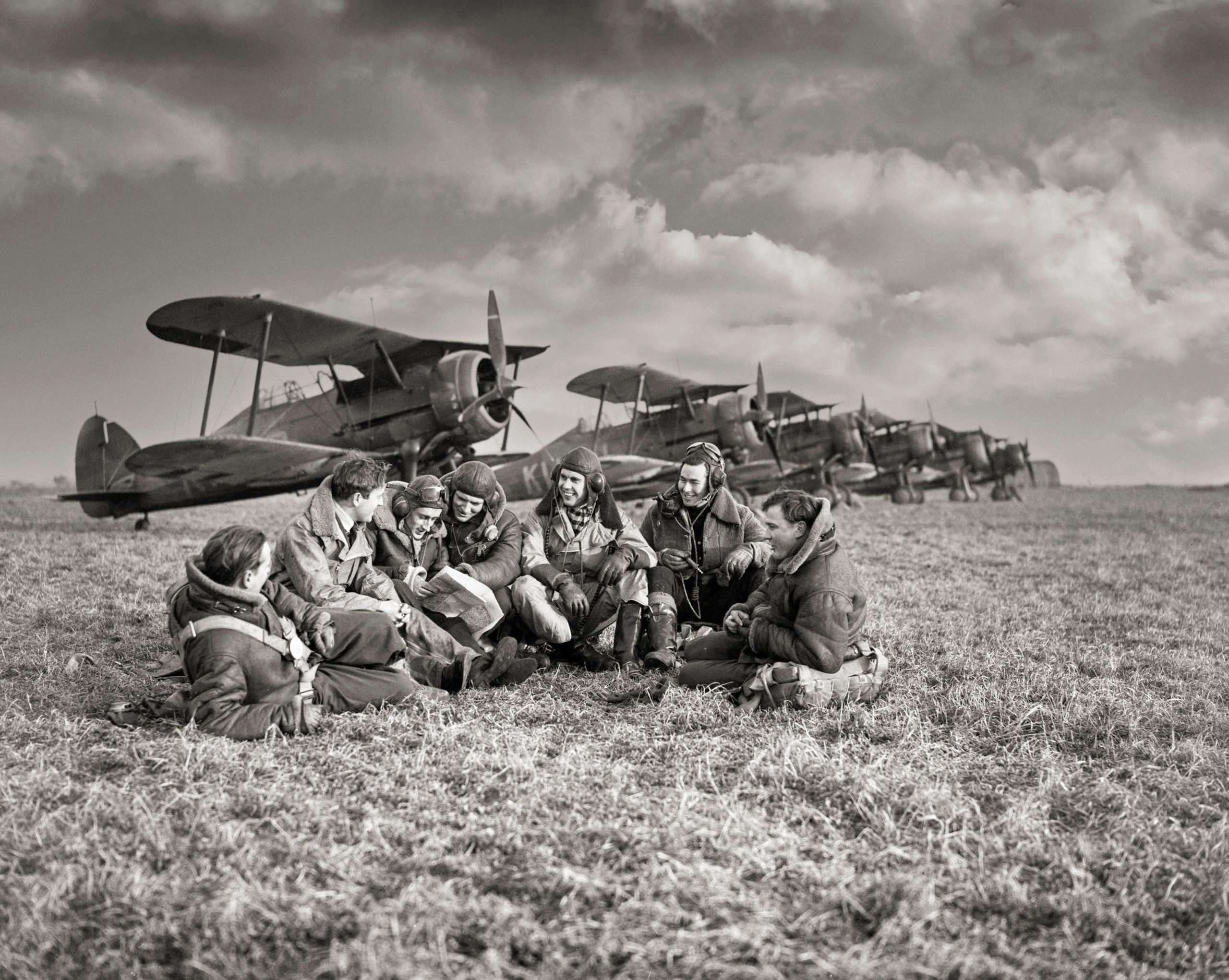
Pilots of 615 Squadron gathered together in front of their Gloster Gladiators – fitted with Constantinesco Fire Control Gears – at Vitry, Northern France, during the early phase of WWII. © Alamy
During the First World War both sides encountered difficulties making effective use of forward firing armaments. The challenge of mounting machine guns on an aircraft so that they could fire forward, through the arc of the aircraft’s turning propeller, was a complex technical problem.
The solution proved to be the synchronisation gear – a device which linked the aircraft’s forward firing armament to the rotation of the propeller.
Improving air-to-air combat
At the outset of the war, aircraft had demonstrated their value by providing reconnaissance of the enemy and observation of artillery fire. Increasingly however, aircraft were sharing the sky with their enemy counterparts. The subsequent confrontations resulted in a need to arm aircraft with effective weapons for air-to-air combat.
Light machine guns could be mounted outside of the propeller arc but heavier machine guns had to be mounted on the airframe at an angle where their field of fire was reduced. To compensate for this limitation, observers were equipped with rear firing armament and alternative designs such as the Vickers FB.5 Gun Bus mounted the engine and propeller behind the crew nacelle, allowing for an uninterrupted forward field of fire.

A Constantinesco gear in position inside the gun end of a Royal Aircraft Factory S.E.5a. © RAF Museum
Damage limitation
It was soon realised that machine guns were fired most accurately during combat when fixed to the airframe and aligned for forward fire in line with the aircraft’s flight. This led to the need for a way to get bullets through the propeller’s arc without damaging the blades.
Attempts to achieve this included the use of armoured propellers which deflected bullets. Although more successful than might be imagined, deflector plates on propellers led to one in every 10 rounds being wasted and an undesirably high loss of speed. It became apparent that what was needed was a device which ensured that no propeller blade was in the line of fire at the point the bullets would otherwise hit the propeller. This required a synchronisation gear.
The concept for synchronising the rotation of the propeller to the guns of an aircraft pre-dated the war. However, the device was not initially needed and the technical complexity required for synchronisation meant its introduction was delayed. It was not until late spring 1915, when the Fokker Eindecker began to operate with the German Air Service, that a purpose built fighter-interceptor entered service using a synchronisation gear.
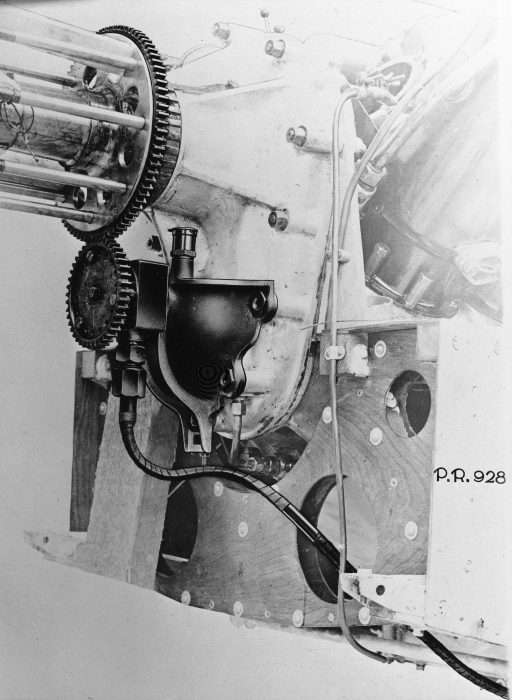
A Constantinesco gear in position inside the engine end of a Royal Aircraft Factory S.E.5a. © RAF Museum.
Regaining the advantage
The Fokker synchronisation gear required the pilot to activate it when they wished to commence firing. Once activated, a cam wheel connected to the propeller shaft would transmit the propeller’s rotation to the gun via a linkage system and push rod. This system only fired the gun when the bullet could pass through the propeller’s arc. However, if the engine stopped the gun could not be fired.
This synchronisation gear provided Germany with an advantage, allowing them to gain air superiority. For British airmen, the summer of 1915 was defined by the ‘Fokker scourge’.
British and French air forces needed to develop their own synchronisation gears and, by summer 1916, several designs were available in quantity. The design of the first British synchronisation gear, the Vickers- Challenger, was similar in principle to the pushrod system of the German design. Subsequent British synchronisation gears offered advances on earlier designs but there were inherent limitations to these mechanical gears.
Mechanical synchronisation gears were restricted in the value they could derive from the increasing speed of new engine designs and improvements in the armament that aircraft could carry. In addition, the wear they suffered in service led to malfunctions where the guns would no longer fire, and desynchronisation, with bullets striking the aircraft propeller.
Harnessing the power of waves
The limitations of mechanical gears led to the Constantinesco Fire Control Gear, or CC gear, becoming standard on British aircraft during 1917. Designed by the engineer George Constantinesco, who had pioneered the theory of mechanical wave transmission, the CC gear employed a hydraulic action.
When firing their forward armament, the pilot activated a generator which converted the rotary movement of the propeller into a wave motion – a process achieved by a cam, moving in synchronisation with the propeller blade, operating a plunger in a cylinder. This wave motion was transmitted as an impulse to the trigger motor via a pipeline filled with oil under pressure. The trigger motor responded to fire the forward armament at the point where the bullet would pass between the blades of the propeller.
The Constantinesco Fire Control Gear was highly effective and by the end of 1917 more than 6,000 had been fitted to British aircraft. Synchronisation gears continued to be an important part of aircraft design for many years, with the last RAF fighter aircraft equipped with the Constantinesco gear being the Gloster Gladiator – an aircraft still in use during the Second World War.

George ‘Gogu’ Constantinescu © SC Romfilatelia SA
George Constantinescu
Born in 1881 in Romania, George ‘Gogu’ Constantinescu (also known as Contantinesco) settled in the UK in 1912, where he worked as a scientist, engineer and inventor. During his career he registered over 130 inventions – including the synchronisation gear he gave his name to. In 2016 he featured on a series of stamps commemorating ‘brilliant Romanians’.
Air Mail
This article is taken from a longer version first published in Air Mail. Air Mail is the RAF Association’s quarterly members’ magazine, which covers all aspects of the RAF and RAF Association’s work from their founding to the present day. To receive Air Mail become a member and opt for Air Mail as part of your membership.