Three quarters of the Royal Air Force’s carbon footprint comes from burning fossil fuels in all kinds of aircraft. And no amount of switching off lights on station, and using electric cars and scooters is going to fully balance out that carbon debt. So the RAF has had no choice but to also move ahead with finding alternative ways to power its training, support, surveillance and attack aircraft.
Over the last three years it has made huge strides in different areas, from electric aircraft to sustainable and synthetic fuels….

The problems it faces are not just technical. The fuels of the future must be sustainable, safe, affordable, able to be made at scale and, as proven by recent world events, the country must have sovereign control of the supply lines. And waste from the creation of aircraft also needs to be reduced: the RAF needs to adopt a circular economy – where the use of raw materials should be reduced, as should waste and pollution, and in which materials should be reused in the production of the next round of equipment and materiel.
Developments in alternative fuels have been quietly going on for some years and have necessarily accelerated recently as the circumstances of climate change became more accepted/evident.
Fuel from thin air
In November 2021, a project that really does make aircraft fuel from thin air was making the headlines. A Royal Air Force test pilot made history with the world's first flight on 100 per cent synthetic fuel – a feat recognised by Guinness World Records. Group Captain Peter 'Willy' Hackett piloted a microlight from Cotswold Airport (formerly RAF Kemble) using fully synthetic gasoline – made from just water and carbon dioxide.
The flight was a major milestone in Project MARTIN, a collaboration between Zero Petroleum – the private company of Paddy Lowe, a former Formula 1 car engineer, and Professor Nilay Shah – and the Royal Air Force.
Wing Commander Nicola Sinclair, of the Royal Air Force's Rapid Capabilities Office explains that carbon dioxide and water: "can be collected from the atmosphere and recombined using energy from renewable sources." When this is burned its only by-product is oxygen.
Initially, only small quantities of the fuel – millilitres – were produced at a site on the Orkney Islands, using electricity generated from wind, tidal and wave energy. The RAF's Rapid Capabilities Office and the Air Innovation Fund invested in this early stage technology with a view to using it across the Air Force if the test flights worked out.
Just after the successful microlight demonstration, Wayne Strachan, Commercial Director at IGCL Technology, which helped develop the fuel, explained: "We didn't produce a huge amount because that wasn't the purpose of the demonstration, it was to prove that we could do it technically, and if we moved onto a more commercial footing, clearly we would be able to produce much higher volumes. It will be expensive, it will require investment but we will drive the costs down."
Synthetic fuel was first used by the Germans in World War II. Scientists Fischer and Tropsch developed the chemical process in the early 1920s using carbon monoxide but the cheapness and abundance of fossil fuels from then onwards meant it was mostly disregarded, until now. The 21st-century version is produced in a completely clean manner using carbon dioxide and can be dropped into existing engines without having to modify them and, as proved by the Project MARTIN flight, without any loss of performance.

Electric aircraft or hydrogen power?
By April 2022, the RAF was also testing the feasibility of using electric aircraft for training. It had been offered early access to a ground-breaking zero emissions aircraft and wanted to gain a better understanding of the new technology. A Pipistrel electric aircraft had already been investigated by Slovenian and Danish air forces, which were looking to develop it further.
A small team of test pilots from the Air and Space Warfare Centre flew a Pipistrel Velis Electro aircraft at two locations. Phase 1 training for the pilots started at Damyns Hall at the end of 2021 and Phase 2 took place at RAF College Cranwell in March 2022. The project explored logistics support and infrastructure requirements, as well as safety, the aircraft itself, and airfield operations. The intention was not to gain insight for a particular procurement, but to test the processes, functionality and implementation of electric aircraft as a concept.
The potential for hydrogen power has been under investigation by the United States government since the 1950s and by commercial and civilian aircraft manufactures for some time since then. And there are developments – from blended wing to conventional-looking airliners. But the limitations of hydrogen fuel still cause difficulties, particularly for military use. While hydrogen fuel's only emission is water, it needs to be stored under pressure at low temperatures, is highly unstable and inflammable, and takes up four times as much storage space as fossil aviation fuels such as AvGas, jet fuel or kerosene. This makes the fuel more likely to be suitable for larger aircraft that carry many passengers or large cargo, but not for fighter jets or lighter uncrewed aircraft such as Reapers. Computer modelling has increased knowledge of hydrogen combustion, and more efficient modern aircraft engines means less fuel is needed. The RAF is currently concentrating on using hydrogen power for flight line support vehicles.

Biofuels
Just a few months after its electric aircraft tests, the RAF ran an initial trial for a new type of aviation fuel as part of Project BIOFUEL. Biofuels can be produced from biomass such as grains, oil seeds, algae, fats, oils and greases, agricultural, forestry and woodmill waste, and also from wastewater treatment sludge, manures or dedicated energy crops.
Based at RAF Northolt, which already powers the station’s electricity needs from local agricultural by-products, the team tested a blend of 35 per cent non-fossil aviation fuel on a multi-engine aircraft – the British Aerospace BAe 146. There are many considerations when looking at sustainable aviation fuel use within Defence and the project was carefully designed to take these all into account. One of the most pressing is the supply chain: the RAF 24/7operations mean it is critical that its aircraft are ready to respond at short notice. A strong supply chain for sustainable aviation fuel is essential to this as well as confidence that aircraft can operate effectively on the new fuels, with no impact on their capabilities.
Sustainable Aviation Fuel – fit for Royalty as well as for Voyagers, Typhoons and Hercules
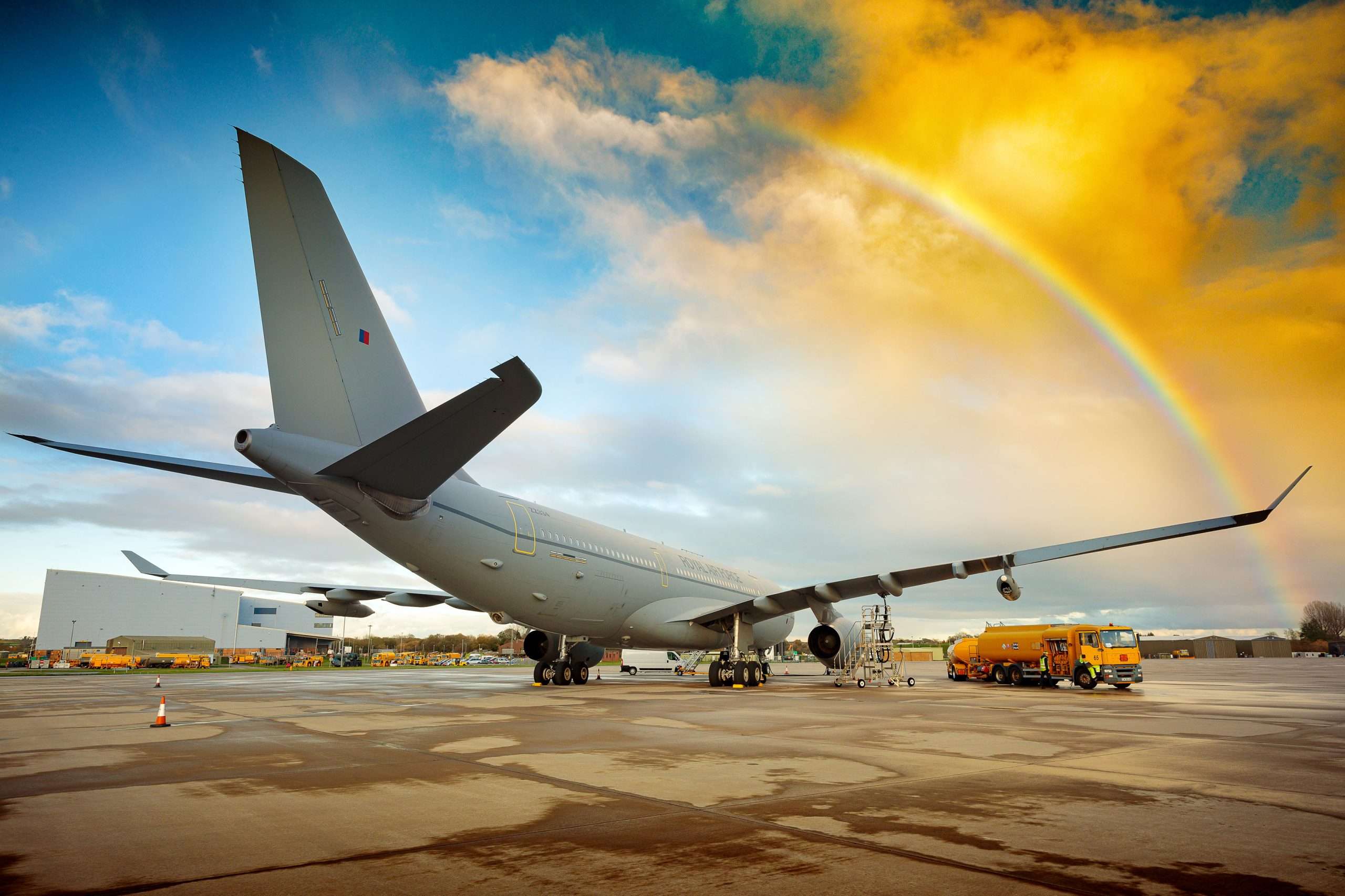
In November 2021, an RAF Voyager flew His Royal Highness Prince Charles and Camilla Duchess of Cornwall (as they were then) to Jordan for an official visit. The aircraft, which is used by UK government ministers and officials as well as the Royal family, was powered by Sustainable Aviation Fuel (SAF) and was the first in the RAF fleet to be converted. Made from waste-based sustainable feedstocks, such as used cooking oil, SAF is expected to be key to reducing the RAF’s reliance on global supply chains and fossil fuels, while improving operational resilience. Created from waste-based sustainable feedstocks like used cooking oil, it cuts lifecycle carbon emissions on average by up to 80 per cent compared to conventional jet fuel.
A year later, in November 2022, Baroness Goldie, Defence Minister, welcomed: “a breakthrough moment for the RAF and an exciting development for the Ministry of Defence.” She was talking about UK’s first 100 per cent sustainable fuel flight for any kind of aircraft (military or civilian). The flight was also a world first for a military aircraft of its size. Again it was an RAF Voyager, and it took to the skies over Oxfordshire powered entirely by SAF. The flight was a joint endeavour between the RAF, Defence Equipment & Support and industry partners Airbus, AirTanker and Rolls-Royce, with the fuel supplied by Air BP. At the same time, Baroness Vere, Aviation Minister at the Department of Transport highlighted the: “£165million Advanced Fuels Fund to kickstart a homegrown SAF industry [and] challenge the sector to deliver the first net zero transatlantic flight next year,” [2023].
By January 2023 a Voyager had tested blending regular jet fuel with 46 to 48 per cent SAF and transferring it to a C-130 Hercules and to a Typhoon. The RAF worked with Air BP to re-certify the fuel and achieve the required standards needed for a safe and effective mission. Squadron Leader Evans, RAF Supply Project Manager said: “This was a first for both Typhoon and the Hercules and we believe we are the first air force to conduct an air-to-air refuel operation with a sustainable aviation fuel blend at this level.
In April this year, the RAF successfully completed a Voyager air-to-air refuelling flight, powered by an approximately 43 per cent blend of SAF. Flying from RAF Brize Norton, over the North Sea and via Farnborough on its return home, the Voyager also undertook air-to-air refuelling with Typhoons, as part of planned training. The flight was part of a two-day industry-led conference called Sustainable Skies World Summit. The annual event, hosted at Farnborough International Airport, brings together various partners from industry to share the latest developments in sustainable aviation technology and support efforts moving towards the implementation phase of meeting its net zero commitment.
The same month, the RAF announced Project MONET. Two experimental aircraft will be used to evaluate how technologies such as all-electric battery power, synthetic fuel internal combustion engines, hydrogen cells and hybrids can meet military requirements. It will also look at the whole-life environmental impact of operating a fleet of such aircraft including logistics, ground operations, human factors, and certification.
This joint initiative between the RAF’s Rapid Capabilities Office and industry partners Babcock and Swift Aircraft will use light training aircraft. It will also evaluate a broader range of factors and provide important sustainability data and information which can be applied to other capability projects and developments.
Group Captain Hackett, in his capacity as Military Head of Flight Test on Team Tempest, said: “MONET will be an exciting journey into the future of sustainable flight for the RAF. We will develop and understand the technologies to enable future military aircrew and air cadets to begin their journey into aviation, and yet not adversely impact the world we all share. I can’t think of a better motivator to push us all on to success.”
The Royal Air Force’s drive towards greater use of alternative and sustainable fuel continues to gather pace. With the potential to maintain or possibly enhance operational ability, this is an important endeavour both for our Armed Forces and our collective mission to tackle climate change.