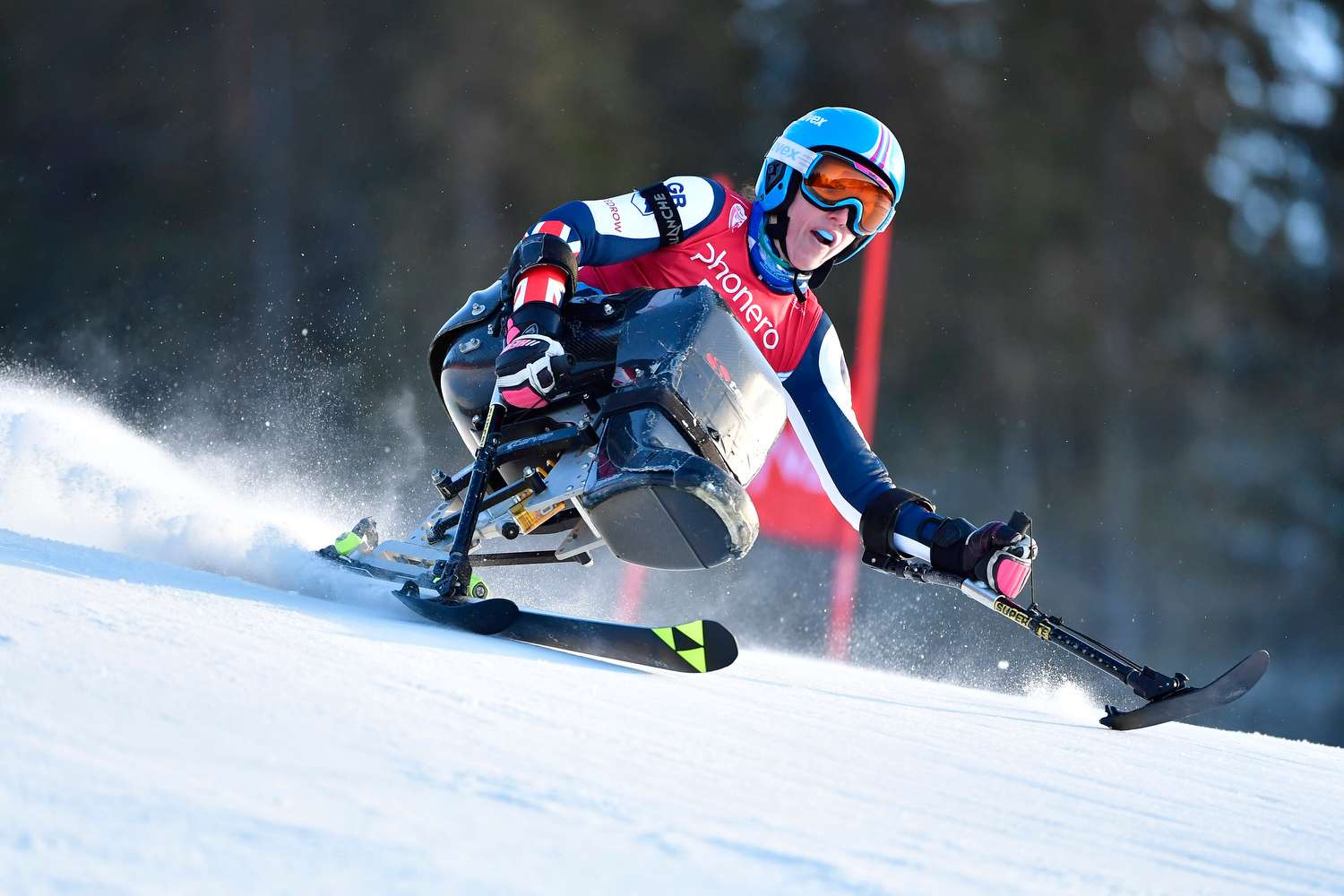
Corporal Shona Brownlee is talking innovation with Air Mail from her home in Livingston, Scotland. She joined the RAF as a musician and is technically based at RAF Northolt. But her place on the RAF’s Elite Athlete scheme has meant she is now able to train full time to keep her place in the Great Britain Para Alpine Skiing Team. “It’s a lot of dialogue with your coaches and the technical support staff because they’ll say: ‘I want you to put more pressure on this turn or something. I’ll give you some direction or you need to be working on this and I might say: ‘Well, I can’t put more pressure on that side because that’s my amputation side and I’m a little bit uneven.’ So, then we have to think well what can we do to balance that out, to even it up?”

In 2012 Shona sustained an injury to her lower leg during RAF training. Six years later she opted for a below-the-knee amputation as her injury hadn’t healed as hoped. She then got a chance to ski in Bavaria through the Battle Back programme, a Ministry of Defence-funded initiative providing adventurous training opportunities to wounded, injured and sick service personnel.
Unusual talent
She showed unusual talent and was given the chance to join the Armed Forces Para-Snowsport Team (AFPST), where she got her first experiences of ski racing in 2019. She says: "I went along to their Newcomers' Day and got a bit intimidated by all this talk about racing and thought: 'Oh, I don't think I want to race.' And then I just I got into it and got hooked, became a bit addicted." By the end of the 2019-20 season Shona had won three gold medals at the British Championships, two gold medals at the Europa Cup finals and finished third overall in the Europa Cup. In 2022, she claimed Super-G silver and Giant slalom bronze at the World Para Snowsports Championships in Lillehammer, Norway. On her Paralympic debut at the Winter Games in Beijing, China she finished sixth in the Super-G and ninth in the Giant Slalom and Slalom.

Para Alpine skiing was one of the foundation events at the first winter Paralympics in 1976. RAF Elite Athlete and GB Paralympian, Corporal Shona Brownlee, describes the finer details of how athletes prepare to compete at more than 100km per hour.
Rules
Shona expands her thoughts about the technicalities of sit skiing: "Because everybody's injuries or impairments are different, each athlete has to personalise their own equipment and make it work for them. "But there are rules about adaptations. Any time you add anything to adapt any of your equipment you have to submit it to the International Ski Federation with pictures and descriptions and say this is what I've done and why and they then approve it or veto it. "Something like putting a weight in would be banned because that's giving you more momentum. But I could have something that would allow me to put more weight through the ski, so I can change the angle of the bucket [seat] or for example, put in a block for my residual limb to rest on so I can put more equal pressure through both legs. And actually, a lot of the athletes who have spinal cord injuries, depending on the height of their spinal cord injury, they can tilt their bucket to make it work for where their injury level is.
Equipment
The majority of our equipment, especially for the stand-up skiers, is just standard. We wear the same helmets, gloves, race suits as any of the able[1]bodied athletes. "But the ski manufacturers are always looking at ways to make their skis faster. And with [para skiing] adaptive equipment, that just depends on the individual athlete really. I think it's a constant innovation thing; everybody's always looking for a way to make themselves that bit faster or get a bit of an edge over their competitors." Shona explains: "There's not somebody who's tasked solely with adjusting my sit ski, for example. It's mainly our coaching staff that we discuss things with. Our ski technicians are the ones who do all the waxing and preparing of our skis. They can also alter the sharpness of the edge or the angle of the edge of the ski or they can use a different wax. This is a bit of a dark mystery to me. They're much more expert than I am, but there are a lot of things you can change depending on conditions or the slope or how you're feeling that day." The ability of a ski to slide over snow depends on the properties of the snow and of the ski. Race skiers aim for an optimum amount of lubrication from melting the snow by friction with the ski—too little and the ski interacts with solid snow crystals, too much and capillary attraction of meltwater slows the ski. Modern plastic materials, such as high[1]modulus polyethylene and Teflon used on ski bases, have excellent gliding properties on snow, which mean a glide wax doesn't add any benefit. But other skis need the wax to reduce kinetic friction. Waxes are matched with the varying properties of snow, including crystal type and size, and moisture content of the snow surface, which all vary with temperature and the temperature history of the snow. The sit-skis themselves are the subject of constant, and sometimes confidential, engineering and materials development. The USA team unveiled a new sit ski engineered by Toyota before the Beijing Paralympics. GB Snowsports worked with Williams Advanced Engineering, BAE Systems, Formaplast and Coventry University on the men's Nordic skiing rig for the same competition. Other suppliers of international teams include Nissin Medical Industries of Japan and the French specialist Tessier – which made Shona's ski – their Scarver model was used by 19 medal-winners at the Beijing games. Showing her deep and ongoing gratitude for the support she received with her first sit ski (loaned for free by AFPST), Shona describes getting into a bespoke race sit ski as: ". like people making the comparison between driving an old banger and then getting into a Ferrari. I wouldn't say easier, but it definitely made a difference. It was a much better fit for me so was a lot more responsive and I could feel more what I was supposed to be doing. Then the year before the Paralympics, I changed my skis. I just had a different brand of ski and that also made a big difference. It was a slightly stiffer ski so, ironically, I had to work harder to make it flex. But it just felt better and worked better for me."

Fuel
Innovation in nutrition is: “quite a tricky one,” Shona explains. “Because things are always changing. One week, somebody is saying: ‘Oh, this is really good and this is the newest superfood.’ And then the next week it’s all different. We’re really lucky; when you’re accepted onto the GB World class program you get access to the English and Scottish Institutes of Sport. And through them we also have access to a whole range of specialists such as strength and conditioning coaches, sports psychologists, dieticians and more. The help is always there if you need it. It’s not forced on you, so people aren’t saying you must go and see the nutritionist and you must eat this thing or not eat this thing. It’s all done on a grownup sensible approach. I’ve tried to become a bit more aware of what I’m doing. You have to think of food and nutrition as fuel. It’s not ‘just eating’ anymore. This is fuelling your workout and making you stronger.”
Marginal gains
The system of marginal gains was pioneered in the British Olympic cycling team and is now widely used in Olympic and Paralympic sports. Any tiny thing that makes an athlete compete better – such as having their own pillow – is done. Collectively this adds up to bigger gains. “That was a big thing before we went out to Beijing,” says Shona. “We had quite a few meetings with Paralympics GB and they were asking what do we want in the athletes’ village and our little apartment? What would we want to make it feel like home or to make it comfortable so that we could be as chilled out as possible in the village and we didn’t need to worry about anything else. Because we’ve got enough stress with the racing. So they took very good care of us from that side of things. In terms of training camps from week to week, it’s very much up to the individual athlete. Some people like to take their own pillows with them. I think everybody just has their own routine that they get into in their own things that they like. When we were in Beijing and when I was at the world champs last year, I couldn’t take my French horn – there just wasn’t time to practice, there wasn’t the luggage capacity, and anyway it probably would have been a bit of a distraction from the big events. On other training camps, like when I was in Canada before Christmas, I had my horn with me. I actually joined the local band for a few weeks and went along to their rehearsals just to get some playing in.”
In the zone
And routines are important on skiing race day too. But where many athletes get in the zone through music, Shona doesn’t. The professional French horn and piano player who also has an MMus in Music Performance confesses: “If I listen to music I don’t switch off. I’m analysing what’s going on in the music. Sometimes that can be a useful distraction for skiing but, pre-racing, I don’t want to be focused on something completely different. I’ve got my own little pre-race routine between the course inspection and starting the race. I’m fairly fortunate; as a female we always race before the male racers. Sometimes the males have an hour, an hour and a half plus of waiting time. By the time I do some warm ups and some breathing exercises and quite a lot of visualisation – just remembering the course in my head – I’m pretty much in the start gate.”
Music training helps
The discipline of learning to play music from the age of seven has had unexpected advantages in Shona’s sporting life. She says people give her funny looks when she compares musical performance to skiing, but she says in practice it’s: “the repetition of trying to make tiny differences – because there’s never a massive change all at once. And having the discipline and the motivation to keep going when things aren’t going well.” And [she sees the] race as a performance. So, the music psychology helps. “Things that I’ve done to help me in music performance help me race. Like the breathing, visualisation and mental preparation I do at the start of both. And it helps with the nerves as well. When I am thinking: ‘Oh! This is terrifying. Why am I doing this?” …I am used to that from the music side. It is different at the top of a ski course, but I know better how to deal with it. I know I’ve done this before.” Acceptance onto the RAF Elite Athlete scheme has made a world of difference to Shona’s professional and sporting life. “I was trying to juggle my fulltime job in the RAF with my training and I didn’t want to give one or the other up. But it just meant that I never had any time off. I was working and RAF Music Services were really supportive and giving me time away to train; they knew how important it was and they also thought it was good for my rehab. Then, when I then came back from training I felt I needed to be in work because they’ve been really supportive. I don’t think it was productive for either music or skiing. Being on the scheme allows me to focus properly on the skiing and to be able to give it a proper go.”

The future
Looking ahead, Shona says: “It’s not quite such a young person’s sport as it might be in the able-bodied world; I think in the para world some people have acquired injuries and so don’t start tilllater. My aim is to qualify and get to the 2026 Paralympics skiing team in Italy. After that I think it probably will be time to go back to work. But that’s not a terrible thing because I really want to go back to the [RAF Central] band. I don’t feel like I’ve quite done my job there yet because I was injured to start with, then when I recovered enough to be with the band, I got into skiing. So, I’ve still got unfinished business with the band…to actually be a musician and do that job full time. And it’s definitely the intention to go back and take care of that.
I think playing French horn in a lot of ways is like being an athlete. You use a lot of muscles to play and if you take a couple of days off and you can feel the [face] muscles aren’t quite as fresh and it makes a difference. That’ll be the main thing when I’m back full time, building up the stamina again. Obviously I’m not going to forget how to read music or what the fingerings are. It’s just getting that technique back. But I’m still trying to keep up with my own individual practice and also do engagements with Music Services when I can out of season, so if I can keep that going, hopefully it will stop too much skill fade from that side of things. My initial RAF contract was 12 years and I’m getting close to the end of that, but I’m hoping to extend it if I can. I still want to have a career as a musician.”