Royal Observer Corps
To mark the 80th anniversary of the Royal Observer Corps being granted its Royal title, Paddy Malone explores the role the Corps played in delivering thousands of aircrew from harm during WW2.
Many people know the outstanding contribution made by the Royal Observer Corps (ROC) during the Battle of Britain, tracking enemy aircraft and relaying this information to Fighter Command. But less well known is the crucial role the ROC played in saving thousands of allied aircraft and their crew.
With no radar coverage available over land early on in the war, any aircraft which lost its way either in the darkness or through bad weather would be in danger of roaming the country until it ran out of fuel or crashed into high ground. With posts staffed by experienced aircraft spotters covering most of Britain, the ROC was seen as ideally suited to the task of assisting these lost aircraft.
One method which the ROC implemented involved the use of searchlights as directional pointers. Upon identifying a lost allied aircraft, ROC observers would request the closest airfield to cone its searchlights and fire signal rockets. Then, using their own searchlight to catch the pilot’s eye, the beam would be elevated to 45 degrees and depressed again three times in quick succession, before finally being pointed horizontally towards the airfield for two minutes or until the sound of the aircraft died away.
This searchlight system was soon followed by ‘Darky’, a short-wave high frequency TR9D radio. This radio had a 10 mile radius and enabled both RAF stations and ROC posts to contact lost aircraft in their vicinity and direct them to the nearest safe airfield.
Another ROC operation implemented to ensure aircraft safety was ‘Granite’, designed to prevent aircraft flying into high ground in poor visibility. If an aircraft was seen to be flying at low altitude towards high ground a red flare would be lit in its path, allowing the pilot to take evasive action. Eventually over 350 ROC posts – primarily in hilly areas of North Wales, the Pennines, and Scotland – were equipped for Granite operations, with around 15 being augmented with radios which sent an audible warning signal to the pilot.
Thanks to these safeguards, air crew lost in the inky blackness over Britain, perhaps low on fuel or nursing damaged aircraft, could rely on a helping hand to guide them home.
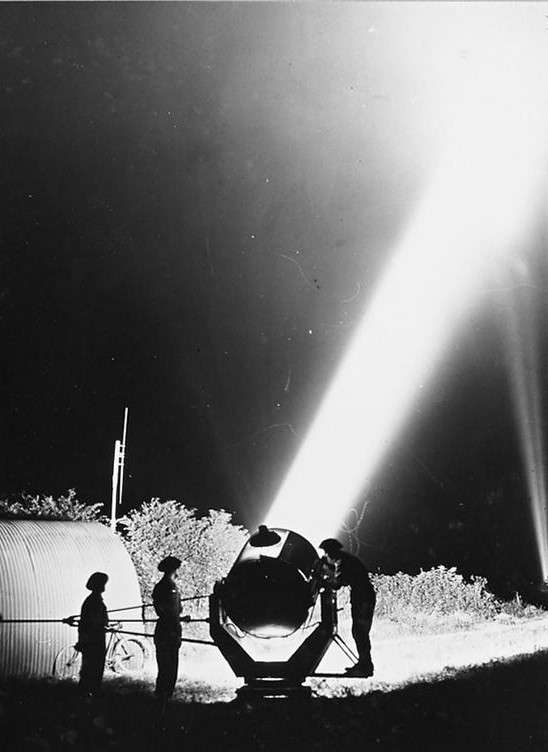
RAF personnel silhouetted against the beam of a searchlight at a northern bomber station. © IWM
Throughout the war, members of the ROC were also involved in rescuing aircrew following crashes, guiding ambulances and rescue vehicles to crash sites and directing air-sea rescue vessels to aircrew downed in the sea.
In May 1945, Air Marshal Sir Roderic Hill thanked the Royal Observer Corps for the vital role they had played during the war:
“Amongst praiseworthy aspects of your work, I must allude especially to your tracking of friendly aircraft” he noted.
“Outsiders, perhaps know little of its merits: but the Royal Air Force knows and is grateful. A very large number of aircrews of all commands owe their lives to your care.”
This story was first published in Oct-Dec 2020 edition of Air Mail, the RAF Association members’ magazine. Non-members can receive Air Mail, plus other membership benefits, by signing up here.